
AS the SADC Sustainable Energy Week unfolds in Victoria Falls, bringing together regional policymakers, investors and energy leaders, Zimbabwe stands in a unique and credible position.
More than a participant in the regional energy transition conversation, Zimbabwe is already a proven market leader in one of the most practical renewable fuel interventions in Southern Africa — ethanol blending.
Zimbabwe’s ethanol blending policy, operationalised in 2013, has become one of the country’s most important, yet often under-appreciated, economic and energy interventions.
Initially introduced to ease fuel shortages and reduce the petroleum import bill, the policy has evolved into a strategic pillar touching foreign currency management, rural industrialisation, energy security and environmental sustainability. More than a decade later, the results are measurable and substantial.
Since the commencement of blending, locally produced ethanol has been blended into petrol at ratios of up to 20 percent, directly substituting imported fuel. Over this period, Zimbabwe has blended about 1 billion litres of locally produced ethanol into the national fuel supply, representing one of the largest renewable fuel substitution programmes in the SADC region.
This volume translates into significant foreign currency savings and reduced dependence on external fuel supplies. In an economy where forex stability remains central to growth and planning, such import substitution is not a minor technical adjustment — it is a strategic national advantage.
Within SADC, few countries have implemented and sustained a blending framework at this scale. Zimbabwe’s policy certainty, regulatory enforcement and production capacity development have positioned the country as a regional benchmark in biofuel integration.
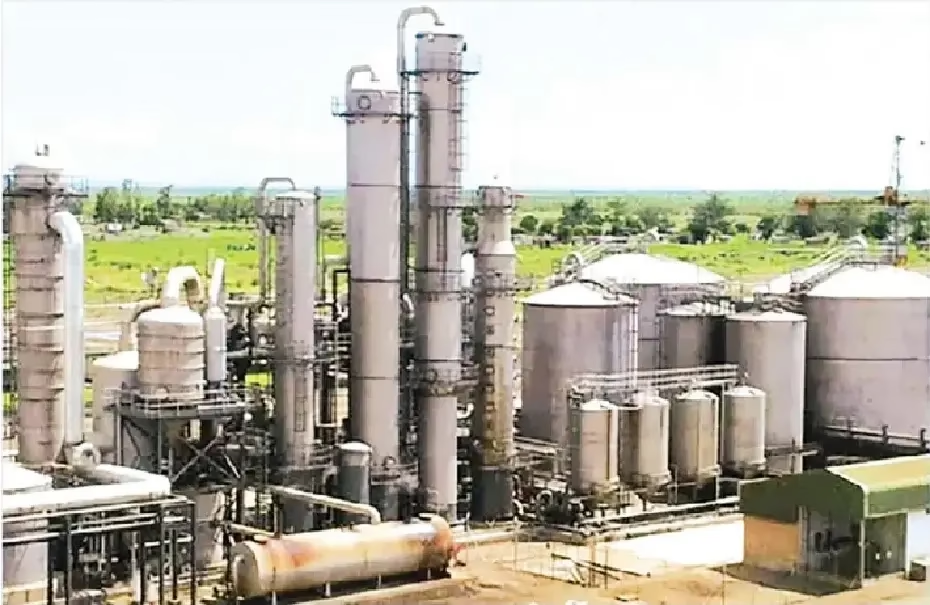
The ethanol sector has, as a direct result of the blending policy, attracted substantial capital investment. Green Fuel, operating in partnership with ARDA, has invested approximately US$300 million to date, with expansion plans aimed at increasing sugarcane
development toward 40 000 hectares and significantly boosting production capacity. Current annual production capacity stands at around 120 million litres per annum, with long-term projections of up to 480 million litres per annum.
Triangle Limited also contributes significantly to national output, with production capacity of approximately 20 million litres per annum, reinforcing the fact that the blending policy supports a diversified and resilient industry base.
Beyond the fuel pump, the socio-economic impact has been transformative. Ethanol production has anchored rural industrialisation in areas such as Chisumbanje, Middle Sabi and Chiredzi.
Thousands of direct and indirect jobs have been created, while out-grower schemes have integrated smallholder farmers into formal agricultural value chains. Infrastructure development has followed investment — roads, clinics, schools, boreholes and supporting enterprises have emerged in surrounding communities. In addition, ethanol production contributes to electricity generation, helping to alleviate national power deficits.
The fiscal benefits are equally significant. Government revenue accrues through excise
duty on ethanol, VAT on sugarcane, corporate taxes and statutory employment contributions.
Regulatory agencies receive licence fees and related payments, while ARDA benefits both through shareholding returns and revenue participation.
An often overlooked advantage is ethanol’s role as a de facto fuel marker. Because blending occurs locally, its presence in petrol helps deter fuel smuggling and strengthens tax compliance.
In this respect, the blending policy enhances revenue protection and regulatory oversight — an important consideration in any economy.
Environmental considerations further reinforce the policy’s relevance, particularly in the context of SADC’s regional sustainability agenda. As a renewable fuel, ethanol reduces carbon emissions relative to pure petrol.
Production also yields valuable by-products such as fertiliser, cattle feed, CO2 gas and cooking fuel, improving resource efficiency across value chains.
The question now is how Zimbabwe builds on these gains — and how it leverages its experience to contribute to regional energy transition frameworks emerging from SADC Sustainable Energy Week.
Other countries, such as Brazil and Paraguay, blend ethanol at levels of between 25 – 27 percent. As domestic production capacity expands, Zimbabwe could prudently consider gradually increasing its blending ratio, deepening import substitution and forex savings.
There is also scope to explore low-percentage ethanol blending in diesel, subject to technical validation and regulatory safeguards. Given the country’s reliance on imported diesel, even a modest substitution could yield significant macroeconomic benefits.
Looking further ahead, policy incentives could encourage the gradual introduction of flexfuel vehicles capable of running on higher ethanol blends such as E85.
At the household level, ethanol stoves offer a cleaner alternative to firewood and charcoal, aligning energy policy with environmental protection and public health objectives.
The evidence of the past decade is clear: Zimbabwe’s blending policy has delivered measurable economic, fiscal and social benefits. It has reduced the petroleum import bill, strengthened energy security, generated employment and rural infrastructure, enhanced Government revenue and contributed meaningfully to environmental sustainability. Few policies operate so effectively across the agriculture, energy and finance sectors at once.
As SADC deliberates on sustainable energy pathways in Victoria Falls, Zimbabwe can speak not merely from theory, but from implementation experience. Ethanol is not simply a blending component in petrol. It is a strategic national asset — and a regional success story — that, if carefully expanded, can continue to support growth, resilience and inclusive development for years to come.