
As July 31 approaches, Zimbabwe finds itself at a familiar yet potent political intersection. The air in the capital is thick with the discourse of constitutionalism, as diverse voices across the political and civic spectrum weigh in on the implications of Constitutional Amendment Act No. 3. What began as a legislative debate in the halls of Parliament has now spilled into the public consciousness, manifesting in calls for a nationwide “stayaway” that have dominated recent headlines.
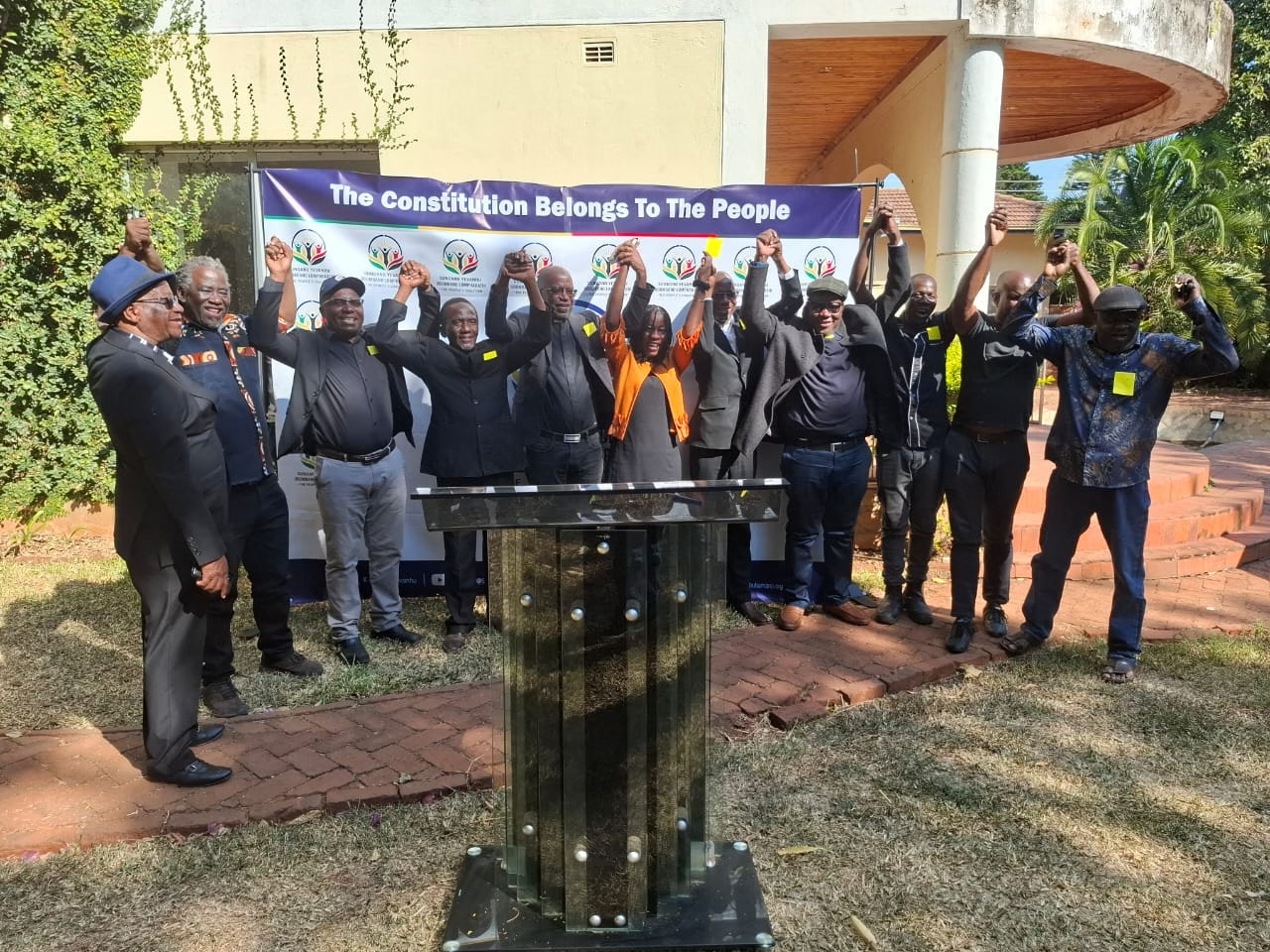
In a significant gathering on Friday, the coalition known as Sungano yeVanhu (Ubumbano loMphakathi) broke its silence. The collective, which brings together an array of civic organizations, church groups, and political entities, used a high-profile press conference to navigate the delicate line between advocacy and orchestration.
Reverend Dr. Kupa Mtata, the coalition’s convener, articulated a position of solidarity with the “citizen-led” call for a peaceful stayaway. However, in a move reflecting the seasoned caution of Zimbabwe’s civic veterans, he was careful to clarify that Sungano yeVanhu is not the architect of the planned action.
“For the avoidance of doubt,” Dr. Mtata told reporters, “Sungano yeVanhu/Ubumbano loMphakathi, its leaders and constituent members, did not organise, convene or call for any activity scheduled for 31 July.”
The press conference featured a “who’s who” of the Zimbabwean opposition and legal fraternity, including constitutional expert Professor Lovemore Madhuku, former Finance Minister Tendai Biti, and activist Jacob Ngarivhume. Their presence underscored the gravity with which the coalition views the recent constitutional changes.
At the heart of the dispute is what Dr. Mtata characterized as a “constitutional coup.” The coalition has already moved to test the resilience of the judiciary, filing multiple applications at the Constitutional Court. Their legal challenge hinges on the argument that the amendment process bypassed essential constitutional safeguards and violated the spirit of the 2013 supreme law.
“The cases are filed. The judges will hear us,” Dr. Mtata remarked, striking a tone of measured institutional trust. “We trust the law and we trust the judges will do the right thing.”
While the coalition maintains its distance from the organization of the stayaway, it has not remained passive on the spiritual front. A nationwide intercessory prayer program was launched on Saturday, with a call for churches to seek “peace, justice, and national unity” during this period of heightened friction.
The government, however, has signaled its own readiness. Home Affairs officials and ruling party representatives have issued a series of stern directives, characterizing the planned stayaway as an unlawful attempt to disrupt a settled constitutional process. Minister Kazembe Kazembe recently emphasized that Amendment Act No. 3 is now the law of the land, warning that any actions deemed to be in defiance of the law would be met with a firm response from security services.
This duality of narratives—one side citing a “constitutional right to peaceful protest” and the other emphasizing “adherence to the rule of law”—defines the current Zimbabwean moment. As the deadline of July 31 looms, the focus remains on whether the nation can navigate this impasse through the peaceful mechanisms of the courts and the quietude of the home, as urged by civic leaders, or if the friction will lead to a more direct confrontation.
For now, the coalition’s message remains one of non-violence. “We reject violence,” Dr. Mtata reiterated, appealing to both the citizenry and the security forces to ensure that the coming days are marked by restraint rather than conflict.
