
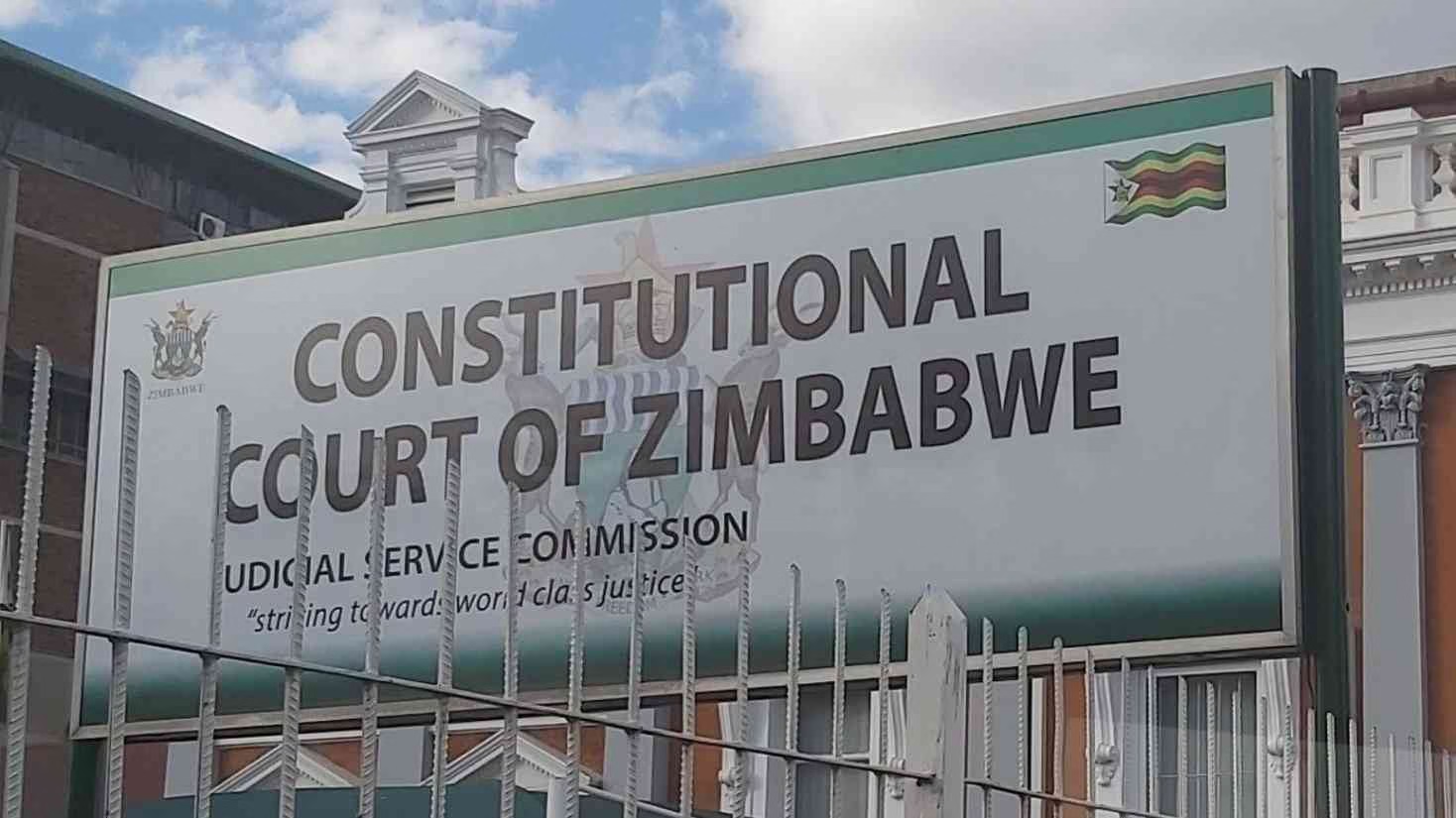
The Constitutional Court of Zimbabwe opened its doors in Harare this morning under the weight of a question that strikes at the very heart of what Zimbabwe was built to be: can a sitting President use the machinery of government to extend his own time in power?
The case — Reuben Zulu + 5 vs The President of the Republic of Zimbabwe N.O. & The Attorney General of Zimbabwe (CCZ 8/26) — began this morning, 20 May 2026.
It is one of the most consequential constitutional cases the country has seen in a generation, and both Zimbabweans and international observers would do well to pay close attention.
What the Case Is About
Six registered voters — Reuben Zulu, Godfrey Gurira, Shoorai Nyamangodo, Joseph Chinyangare, Digmore Knowledge Ndiya, and Joseph Chinguwa — filed an urgent application at the Constitutional Court in February 2026 under section 167(2)(d) of the Constitution. Their complaint is straightforward but profound: President Emmerson Mnangagwa has failed to fulfil his constitutional obligations by presiding over Cabinet proceedings that approved Constitutional Amendment Bill No. 3 of 2026 (CAB3).
They are not opposition figures acting from partisan motives. In the words of lead applicant Reuben Zulu, this action is driven by “constitutional alarm and at the foreboding harm occasioned by the 1st Respondent through his cabinet.”
The Constitutional Issues at Stake
CAB3 is challenged on two main grounds. First, it would alter the method by which the President is elected, shifting away from direct election by universal suffrage — a founding value enshrined in sections 3(2)(a), (b), and (i) of the Constitution and one of the core principles of the liberation struggle: one person, one vote.
Second, the Bill would extend the current Presidential and Parliamentary terms by two years, postponing elections that would otherwise be due. Section 328(7) of the Constitution is explicit that an incumbent cannot benefit from a term-limit amendment.
The applicants argue that the President’s role in advancing this Bill — as constitutional head of Cabinet under section 105(1) — is a direct breach of his duty to uphold and defend the Constitution.
There is also a stark conflict of interest allegation. The President chaired the very Cabinet meeting that approved a proposal from which he personally stands to benefit, in apparent violation of section 196(2), which requires public officers to avoid any conflict between their personal interests and their official duties.
The Constitution, the applicants argue, does not permit those entrusted with executive power to redesign the terms of their own authority while still holding office.
The Fight to Broadcast — and the Door That Was Closed
On 4 May 2026, Atherstone & Cook — acting for Sources Media Network, publisher of All Zim News — wrote urgently to the Judicial Service Commission requesting authorisation for live coverage of today’s proceedings. Their argument was simple: a matter of this national significance, heard at the apex court, should be accessible to the people whose constitution is being interpreted.
That request was denied. In a letter issued yesterday — on the eve of the hearing — the Constitutional Court informed Atherstone & Cook that following a case
management meeting held on 19 May 2026, the Honourable Chief Justice determined that “no sufficient basis has been demonstrated to warrant the granting of the request for live coverage inside the courtroom.”
However, that ruling does not close the matter. A decision made by a single judge in chambers is not, in law, a decision of the full Constitutional Court. Any aggrieved party has the right to bring the question before the full bench (all the judges sitting together) for a fresh determination.
That is precisely what happened this morning: before the main hearing began, the full bench was asked to rule on whether this case should be broadcast to the public.
This is not a minor procedural point. On a matter of such national importance, and consistent with past practice at the Constitutional Court, the question of media access is substantive — it goes directly to whether justice is seen to be done. Sources Media Network is formally appealing that decision. The refusal is itself a matter of public concern. The irony is difficult to ignore: a case about constitutional accountability will now proceed shielded from the very public scrutiny that live coverage would have provided. The decision to close the doors, on the day before the hearing, after a same-day management meeting, raises questions the JSC and Chief Justice should be prepared to answer.
Why Everyone Should Be Watching
This case does not exist in isolation. It arrives at a moment when several African democracies are confronting the same temptation: using constitutional amendment mechanisms to circumvent the term limits those constitutions were designed to protect. For regional bodies, foreign governments, and international civil society, today’s hearing is a litmus test for the health of Zimbabwean democracy.
It is also worth noting that Vice-President Constantino Chiwenga is abroad as the hearing gets under way, attending the World Urban Forum in Baku and a technology
conference in Russia. Some commentators have read his absence as a signal of respect for the separation of powers — a senior executive figure allowing the courts
to do their work without political proximity. Others will draw their own conclusions. Either way, how the Executive positions itself around today’s proceedings will be watched closely.
The applicants have not asked the court to make a political judgment. They have asked it to do what constitutions exist to enable: hold those in power accountable to the rules that govern them. Section 88(1) is unambiguous: executive authority derives from the people, not from a Cabinet chaired by the very person who stands to benefit from its decisions.
The denial of live broadcast authorisation should not diminish wide written reporting. It will only serve as a reminder of why independent journalism matters. The
Constitution belongs to the people. The court will decide whether those entrusted with it remember that.
